Why Your Room Looks Perfect on Paper but Feels Totally Wrong to Live In
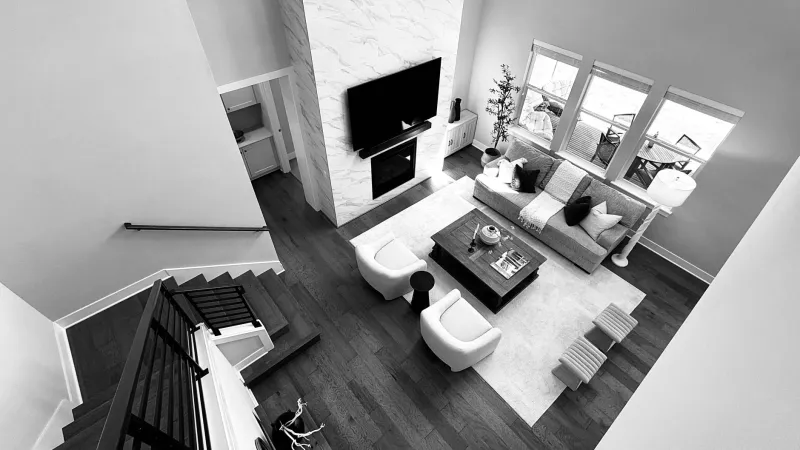
You spent a Sunday moving the couch three different times. You centered the rug, balanced the side tables, and even did that thing where you stand in the doorway squinting to check the symmetry. The room looks right. And yet — every time you sit down in it, something nags at you. It's not quite relaxing. Conversation feels a little awkward. You can't put your finger on it.
You're not imagining it. There's a real and surprisingly common gap between layouts that look balanced and layouts that actually work for the humans living in them. Fixing it starts with understanding why that gap exists in the first place.
The Visual Brain vs. The Body in Space
Here's the thing about interior design: we tend to evaluate it with our eyes, but we experience it with our entire bodies. When you look at a room, your brain processes symmetry, color balance, and proportion. But when you live in a room, your nervous system is tracking something else entirely — how easy it is to move through the space, where your eyes naturally land when you're at rest, whether you feel exposed or protected, and how much effort it takes to do everyday things.
A layout can nail the visual checklist and still fail every one of those experiential tests. That's the trap.
Traffic Flow Is the Silent Culprit
One of the biggest reasons a room feels "off" is disrupted traffic flow — and it's almost invisible until you know what to look for. Traffic flow refers to the natural paths people take to move through a room. When furniture interrupts those paths, even subtly, your brain registers a low-level friction every single time you navigate the space.
Think about the living room where the coffee table is just slightly too close to the sofa. Technically, it looks proportional. But every time you stand up, you have to do a small sideways shuffle. Multiply that by thirty times a day and your body starts to associate that room with mild annoyance.
The diagnostic: walk through your room as if you're moving from one activity to another — from the couch to the kitchen, from the door to the desk. Do you have to angle your body, step around anything, or pause to recalibrate? If yes, that's your flow problem right there.
A general rule of thumb: aim for at least 36 inches of clear walkway on primary traffic paths, and 18 to 24 inches around secondary furniture. It sounds clinical, but your body will thank you.
Sightlines and the Anxiety You Didn't Know You Had
Where your eyes land when you enter a room — and when you're seated in it — matters more than most people realize. Interior designers talk about "sightlines" as a compositional tool, but there's a deeper psychological layer here.
Humans instinctively feel more comfortable when they can see the entrance to a room from wherever they're sitting. It's an old survival instinct, but it still operates quietly in modern living rooms and home offices. If your sofa has its back to the door, or your desk chair faces a blank wall with the entrance behind you, you may feel a persistent, low-grade unease without knowing why. It's not dramatic — it just takes the edge off your ability to fully relax.
Try this: sit in your usual spot and notice where the room's entrance is relative to your eyeline. If you can't see it without turning around, consider reorienting your seating. Even a slight angle can make a meaningful difference in how settled you feel.
Sightlines also apply to what you do see when you're at rest. If your primary view from the couch is a cluttered corner, a blank wall, or the back of another piece of furniture, your brain has nothing satisfying to land on. A focal point — a window, a piece of art, a fireplace — gives your eyes somewhere to rest, which in turn helps your mind do the same.
The Conversation Pit Problem (And It's Not Just Pits)
Another underrated factor is conversational geometry. The way furniture is arranged either encourages or discourages natural interaction, and you feel the result even when you're alone.
Seating arranged in a straight line — think: two chairs facing the same direction, or a sofa with no adjacent seating — creates a spatial awkwardness that makes conversation feel effortful. People end up craning their necks or half-turning in their seats, which is subtly uncomfortable. The ideal conversational arrangement positions seating at angles to each other, roughly 90 to 120 degrees apart, with a shared surface (like a coffee table or ottoman) anchoring the grouping.
This isn't just for entertaining. Even if you live alone, a layout that's built for comfortable interaction tends to feel more alive and welcoming — to you and to anyone who visits.
Your Diagnostic Checklist
Before you move a single piece of furniture, run through these questions:
- Can you walk through the room's main path without adjusting your stride or body angle?
- From your most-used seat, can you see the room's entrance?
- Does your eye have somewhere interesting to land when you're at rest?
- Is your seating arranged so that people (or you) can face each other without strain?
- Is the furniture scaled to the room, or are pieces competing for space?
If you're hitting snags on two or more of those, you've likely found your culprit. The good news: most of these fixes don't require new furniture. They require a different arrangement of what you already have — which is exactly the kind of thing a layout refresh was made for.
The Takeaway
A room that looks right in photos isn't automatically a room that feels right to live in. Visual balance is one piece of the puzzle, but the rooms that genuinely feel good — the ones you actually want to spend time in — are the ones that account for how people move, where they look, and how safe and at ease their nervous systems feel. Once you start seeing layout through that lens, you'll never look at a floor plan the same way again.